

2026.10.27 Teacher's Voice-鶴高の先生にインタビュー
【Teacher's Voice】鶴高の先生にインタビュー#6【英語科 ジョナサン先生】
【Teacher's Voice #6】ジョナサン先生 ~Your golden time starts now~
教員のリアルな想いや日常をお届けする連載企画「Teacher’s Voice」。第6回となる今回は、ジョナサン先生にお話を伺いました。
実は、鶴高の英語科教員の中で、最も長く鶴高に勤めているというジョナサン先生。明るく、優しく、ユーモアたっぷり。知識も豊富で、まさに鶴高きってのエンターテイナーです。鶴高生なら誰もが知っている存在ですが、その素顔やこれまでの歩みを知る機会は、意外と少ないのではないでしょうか。
今回は、先生の意外な経歴から、教育への想い、そして鶴高生へのメッセージまで、たっぷりお届けします。いつものジョナサン先生とはひと味違う一面を、ぜひお楽しみください。
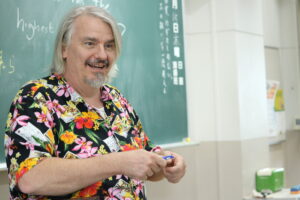
1. これまでの歩み
――ジョナサン先生、こんにちは! 今回の「Teacher’s Voice」にご登場いただけることになり、とてもうれしいです。
ジョナサン:こちらこそ、うれしいですね。鶴高で働けていることを、とても幸運に思っています。
――まずは、先生がどんな道を歩んでこられたのか、教えていただけますか。
私は1972年、カナダのトロントで、アメリカ人の両親のもとに生まれました。1970年代初めに、なぜカナダで生まれたアメリカ人がこんなに多かったのか。その理由は、ぜひ読者の皆さんに考えてもらいたいですね。ちなみに、私はカナダとアメリカ、両方の国籍を持っています。
12歳まではカナダで暮らし、その後アメリカに移りました。育ったのは主にアメリカで、高校はオハイオ州のデイトンにある学校に通っていました。
――先生はよく故郷の話をされますよね。確か、かなり「退屈な」街なんでしたっけ?
ジョナサン:そうですね、退屈な街と言えるかもしれません(笑)。でも実は、今の私たちの生活に欠かせないものが、いろいろと生まれた街でもあるんです。飛行機や自動車のセルフスターター、さらにはインターネットの検索エンジンとも関わりがあるんですよ。
――そうなんですか?
ジョナサン:デイトンは、さまざまな技術や発明と縁のある街なんです。そういうところが、私にとっては面白いんですよね。
――すごいですね! 全然知りませんでした。技術や新しいものを生み出す街なんですね。
ジョナサン:かつては特許でも知られていました。缶ジュースなどを開けるプルタブや、製氷皿もデイトンと関係があるんです。本当にいい街ですよ。街の中心部には、そこで生まれた発明や技術革新を記念する場所もあるんです。
――故郷が大好きなんですね。
ジョナサン:いろいろな場所で暮らしてきて、どこにでも良いところと悪いところがあるとわかりました。カナダもアメリカもペルーも日本も、そこは同じです。長く暮らしていると、やがてその場所が自分の故郷になり、良いところも悪いところも見えてくるんですよ。
だから、デイトンには誇りを持っています。でも、もっと良くできるところもたくさんありますけどね。
――アメリカでの生活の後は、どのような道に進まれたのですか。
ジョナサン:大学では歴史学と地質学を学び、2つの学位を取得しました。
――国籍が2つで、学位も2つ!
ジョナサン:そうなんです(笑)。卒業後は、地質調査を行う会社に就職しました。
専門は水文地質学といって、環境浄化に関わる分野です。家庭の蛇口から出る水が、きれいで安全なものであるようにする仕事をしていました。
ところが、会社の経営状況が悪くなり、大幅な人員削減が行われたんです。私は入社してまだ間もなかったので、早い段階で職を失うことになりました。
同じ分野で働いていた人たちも、全国各地で次々と職を失っていました。私も次の仕事を見つけられなかったんです。
でも、退職するときに、半年分ほどの給料に相当する退職金を受け取ることができました。そのお金を使って、ペルーへ移住したんです。
――先生の経歴は本当にユニークですね。人文系の歴史学と理系の地質学、両方の学位を取得するのは、日本の高校生にとってはかなり珍しいことだと思います。その経験は、その後の人生にも影響しましたか。
ジョナサン:今、同じことをやり直せるとしても、きっと同じ選択はしないでしょうし、生徒たちにも勧めないと思います。正直、時間を無駄にしてしまったと感じているんです。もしやり直せるなら、学士号を1つ取得した後、修士課程に進みます。学士号を2つ取るために費やした時間と労力があれば、学士号と修士号の両方を取得できたと思うんです。
あれは間違いだったと思います。でも、人生では誰だって間違えますよね。後から振り返ると、「もっとこうすればよかった」と思うことは必ずあります。私にとっては、その一つです。
――そういうことも率直に話してくださるのが、先生らしいですね。その後、ペルーへ行かれたのですね。
ジョナサン:そうです。ペルーで家を買い、暮らしを楽しんでいたのですが、やがてお金が尽きてしまいました。生活していくために、仕事を見つけなければならなくなったんです。
そこで、パブの奥で英語を教え始めました。時給は5ドルでした。
楽しかったですよ。若かったですし、英語を教えることも好きでした。でも、これをずっと続けていくのは難しいと感じるようになりました。
そこでアメリカに戻り、英語を教えるための資格を取得しました。そして、次に暮らす場所を探し始めたんです。
自分が生活していけるだけの収入を得られそうな場所として考えていたのは、アルゼンチン、韓国、モザンビーク、日本の4か所でした。
アルゼンチンは、すでにスペイン語が話せたので選びませんでした。韓国とモザンビークにも特に惹かれなかったので、最終的に日本へ来ることにしたんです。
――日本は、それまであまり知らない国だったのですね。
ジョナサン:まったく知りませんでした。日本に来る前は、特に興味があったわけでもなく、本当に何も知らなかったんです。
――遠い国で、なじみもなかったのですね。
ジョナサン:そうですね。日本については何も知りませんでした。来た理由はお金です。それだけでした(笑)。
日本には5年間だけいるつもりでした。教えることが本当に好きだったので、「これを仕事にしたいし、とりあえず挑戦してみよう」と思ったんです。でも、5年経ったらアメリカに帰って、向こうで仕事を探すつもりでした。
来日した当初は藤沢に住み、現地の学校で働いていました。その後、岡山に移り、当時大手だった英会話スクールの会社で働きました。
当時は大手の英会話スクールが4社あったのですが、そのうち2社は今ではなくなっています。私の仕事は、問題が起きた教室へ行って、代わりに授業を担当することでした。いわば、代講の先生のような仕事ですね。そのおかげで、中国・四国地方のいろいろな場所で暮らすことになりました。
やがて、もっと安定した形で英語を教えたいと思い、東京に戻りました。でも、その仕事を続けるうちに、自分が目指せるところには限界があると感じるようになったんです。ある程度までは昇進できても、その先に進むのは難しい。日本で働く外国人として、キャリアアップの難しさを感じることもありました。
そこで、高校に教師を紹介する人材派遣会社で働くことにしたんです。
――それが、鶴高との出会いだったのですね。
ジョナサン:そのとおりです。鶴高は、私が最初に担当することになった学校の一つでした。実は、前任の先生が休暇でニュージーランドに帰国した際、足を骨折してしまい、日本に戻れなくなったんです。それで、私が代わりに派遣されました。
――そんな経緯があったんですね!
ジョナサン:そうして、2002年9月半ばに鶴高に来ることになりました。今では、英語科の中でもかなり長く勤めている教員の一人です。もう24年になりますからね。
私が来た当時も、すでに長く勤めている先生方が何人もいました。今の同僚の中には、私があと1年早く着任していたら、教えていたはずの先生もいるんですよ。つまり、1年早く来ていたら、その先生は私の生徒だったということです。
確かに長くいますね。もう四半世紀近くになりますから。
2. 日本が自分の居場所になった理由
――世界のさまざまな場所で暮らし、働いてきた先生ですが、人生を築く場所として日本を選んだのはなぜですか。
ジョナサン:お金です!
――お金ですか!(笑)
ジョナサン:まあ、それだけではありませんけどね。日本に来たきっかけはお金でしたが、日本に残ることにした理由は別にあります。
日本での5年目が近づいた頃、実はアメリカに帰る準備を進めていました。向こうでの就職面接も、いくつか予定していたんです。
ところが、ちょうどその頃、とても特別な人に出会いました。彼女はいつも笑顔で、「どうしてこんなに楽しそうなんだろう」と不思議に思ったのを覚えています。もっと彼女のことを知りたいと思い、デートに誘いました。
一緒に過ごす時間が増え、ただ歩きながら、いろいろな話をするようになりました。初めてのデートで、結婚についてまで話したんですよ。将来のことや、どんな人生を送りたいかについて、お互いの考えを語り合いました。そして、3回目のデートの頃には、彼女と結婚したいと思っていました。
それから約20年が経ち、今では3人の子どもがいます。
――日本に残ることを決めたのは、愛する人との出会いがあったからなんですね!
ジョナサン:そう言えるでしょうね! もう日本を離れようと、ほとんど決めていたんです。それなのに、一度のデートが人生を変えました。仕事のためだけに来たはずの国が、いつの間にか自分の居場所になっていたんです。
3. 鶴高生の魅力とは
――以前、鶴高の生徒が好きなのは、みんな「普通」だからだとおっしゃっていましたよね。その言葉には、どんな意味があるのでしょうか。
ジョナサン:もちろんです。ありがたいことに、私はこれまで日本各地の中学校や高校で教える機会があり、学力もさまざまな生徒たちと接してきました。学校によって生徒の学力層も違いますし、女子校でも男子校でも教えてきました。
その中でも、鶴高は生徒の多様性という点で、最も際立っている学校です。
卒業生の進路も本当にさまざまです。美容師になった人もいれば、ビジネスの世界で働く人、公務員になった人もいます。ミス日本になった人もいるんですよ! 高校に通いながら、作家として成功した生徒も知っています。確か、高校1年生のときに『Surfer』という本を書いた生徒です。高校生のうちに、すでに本を出版していたんです。
文化的な背景や家族のルーツも、実にさまざまです。
鶴高は本当に多様な学校で、生徒一人ひとりの個性も違います。卒業生たちが社会に出て、それぞれの場所で、それぞれの道を歩んでいる姿を見るのはすばらしいことです。
いろいろな世界を見てきた私からすると、鶴高はこれまで経験してきた中で、最も多様性に富んだ場所です。
私が言う「普通」は、褒め言葉なんですよ。
4. 一人ひとりの英語力に合わせた授業づくり
――ALTチームのリーダーとして、カリキュラムの開発や教材づくりにも携わっていますよね。高校1年生ではペアワークが多く、2年生になると個人発表や創造的なプロジェクトに取り組む機会が増えると聞いています。こうした授業の進め方には、どんな考えがあるのでしょうか。
ジョナサン:難しい質問ですが、とても興味深いですね。
1年生の授業では、英語が得意な生徒も、まだ自信がない生徒も、それぞれの力で取り組める活動を用意するようにしています。
例えば、1年生の早い時期に行う活動の一つに、飛行機の中での会話があります。とても基本的でシンプルな内容ですが、生徒によって答えを自由に広げられるんです。
英語があまり得意でない生徒でも、すでに知っている表現を使えば、きちんと課題をこなせます。基本的には、客室乗務員が乗客に「何を召し上がりますか」と尋ねる場面です。
一方、英語が得意な生徒なら、そこからさらに話を広げて楽しむことができます。珍しい食べ物や天気の話をしてもいいですし、野球選手になりきってもいい。自分で面白い設定を考えてもいいんです。
このように、1年生では、英語力に関係なく誰もが参加でき、それぞれのレベルで取り組める自由度の高い活動を大切にしています。
今は、紙芝居にも取り組んでいます。英語にあまり自信がない生徒でも、十分に良い発表ができますし、英語が得意な生徒なら、物語をさらに発展させて、もっと面白い作品に仕上げることもできます。
2年生になると、日本人の英語科教員が授業で扱う内容と、私たちの授業をもっと結びつけるようにしています。そのため、文法を学ぶだけでなく、実際に使ってみることにも重点を置いています。
5W1Hや過去分詞、動名詞などを扱い、実際の生活を想定した課題の中で使っていくんです。
――文法を覚えるだけでなく、実際にどう使うのかを理解してほしいということですね。
ジョナサン:そのとおりです。私にとっては、数学に少し似ています。
学生時代、私は数学がとても苦手でした。嫌いでしたし、抽象的な概念を理解するのも難しかったんです。
ところが、高校2年生のとき、銀行や科学など、現実の世界と結びついた数学を学ぶようになりました。物理はとても得意だったんです。数学が実際の現象と結びついていたからですね。
英語の文法も同じで、細かなルールを覚えることに集中しすぎると、日常生活でどう使うのかが見えなくなってしまうことがあります。
日本人の英語科教員が教えている大切な内容を、生徒たちが実社会でどう活用できるのか。それを伝えたいんです。日本人の英語科教員と私たちALTが、パートナーとして協力しながら教えていくことを目指しています。
これは、私が長年大切にしてきた目標の一つです。ただ、今は新たな課題にも直面しています。
5. AI時代の英語教育
ジョナサン:AIによって、私たちの生活や仕事のやり方は大きく変わりつつあります。そこで今、生徒たちがすでに使っているツールを取り入れ、AIを活用しながら英語での課題に効果的に取り組む力を育てる、新しいカリキュラムを考えています。
AIが存在しないかのように振る舞ったり、AIと張り合おうとしたりするのではなく、どうすれば生徒たちがAIを上手に使えるようになるのかを考える必要があるんです。
私が学生だった頃、「グラフ電卓」というものがありました。ご存じですか? 画面が付いた電卓で、三角関数や微積分などの数式を入力すると、計算結果を表示してくれるものでした。
――日本でいう関数電卓ですね。
ジョナサン:なるほど。グラフ電卓が登場したばかりの頃、先生たちは教室で使うことを禁止していました。「使ってはいけません」と言っていたんです。
でも、10年ほど経つと、学校もグラフ電卓を受け入れ、生徒たちに使い方を教えるようになりました。
AIについても同じだと思います。AIが存在しないかのように振る舞ったり、生徒たちが将来、実社会でAIを使わないと思い込んだりするのは、賢明ではありません。将来の仕事やビジネス、日常生活で直面する課題に取り組むために、AIをどう活用すればよいのかを教えていく必要があります。
今、私が取り組んでいるのは、まさにその課題です。
そのための教材も開発しています。できれば、今後1、2年のうちに授業に取り入れたいと思っています。
――新しいAI活用型のカリキュラム、楽しみにしています!
ジョナサン:私も実現させたいと思っています。でも、なかなか簡単ではありません。開発を始めたのは約2年前なのですが、ようやく良いカリキュラムができあがったと思った頃には、AIのほうがすでに進化してしまっていたんです。それまでに作ってきたものの多くを、やり直さなければなりませんでした。
でも、そうやって試行錯誤を重ねていくものですよね。
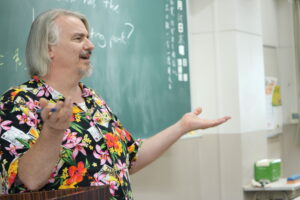
6. 生徒たちの夢を支える
――先生は、鶴高の国際交流でも大きな役割を担っていますよね。特に、海外大学への進学を目指す生徒たちへのサポートは、とても心強いものだと感じています。最近では、出願手続きやエッセイの作成、海外の奨学金への応募なども手伝っていらっしゃいます。海外の大学への進学や、国際的な仕事を目指す生徒たちを支えようと思うのは、なぜですか。
ジョナサン:どの生徒に対しても、気持ちは同じです。何かを成し遂げる手助けをしたいんです。
教師としての自分の役割を例えるなら、生徒たちが上っていく階段の一段のようなものだと思っています。生徒たちは、私が持っている知識や情報などを活用し、次の段階へ進んでいきます。私を足がかりにして、さらに先へ進んでいくんです。
それぞれの夢に向かって進む生徒たちを、土台の部分で支えたい。自分にできることがあって、それが生徒の目標達成につながるなら、それが私の原動力になります。
例えば、英検のスピーキングテストの練習でも、日本の大学に提出するエッセイの作成でも、試験勉強でも、頼まれれば力になりたいと思っています。
特定の何かだけを支援したいというわけではありません。
人の役に立ちながら生きることは、幸せを見つけるための最良の方法の一つだと思っています。
自分のことや、自分が幸せになることばかり考えていると、かえって幸せを感じられなくなる人も多いのではないでしょうか。でも、誰かを支え、その人の人生に喜びをもたらし、困っているときに力になる。そうやって生きていると、すばらしいことが起こるんです。人に与えれば与えるほど、自分にも返ってくるものがあります。
自分の幸せにこだわりすぎると、かえって幸せが遠のいてしまう。一方で、誰かのためになる生き方をしようとすると、自分自身も幸せになれるんです。
少なくとも、私はそう感じてきました。だから、ある意味では、自分のためにやっているとも言えますね。誰かが成功する姿を見ると、私もうれしいんです。
7. 今の鶴高生と、これから鶴高に入学する皆さんへ
――最後に、今の鶴高生と、これから鶴高に入学する皆さんへ、メッセージをお願いします。
ジョナサン:皆さんが何かを成し遂げたいと思ったとき、その実現を手助けするために私たちがいる。そのことを忘れないでほしいですね。
皆さんは若く、知性にあふれています。そして、皆さんが何か意義のあることを成し遂げられるようにと、学校に通わせてくれる保護者の方々がいます。
日本の生徒たちを見ていて感じるのは、少し遠慮しすぎてしまうことがある、ということです。そのためらいが、自分自身の可能性を狭めてしまうこともあります。自分がやりたいことに向かって、もっと積極的になっていいと思うんです。
パン職人になりたいなら、目指せばいい。ごみ収集の仕事に就きたいなら、それもいい。鉱山について学びたいなら、そうすればいい。世界一のeスポーツプレーヤーになりたいなら、挑戦すればいいんです。今の皆さんには、あらゆる可能性が開かれています。
世界は、人間がいなくても同じように存在し続けるものではありません。もし明日、人類がすべていなくなってしまったら、すべてが終わってしまいます。何も続いてはいきません。
うまく伝えられているかわかりませんが、時間が進めば、皆さんの後には次の世代が続いていきます。そして、今は皆さんにとって、人生で最も輝かしい時期-Golden Timeなんです。
私自身の黄金期は、もう過ぎてしまいました。今は、私の子どもたちがその時期を迎えています。年齢を重ねると、自分のやりたいことを何でもできるわけではなくなると気づくものです。でも、若い世代には、これから先にたくさんの可能性が広がっています。
本当に、数え切れないほどの可能性があるんです。
例えば、私の子どもたちも、将来どんなことをしたいか、どんな経験をしてみたいかを考えています。新しいことを学んだり、今まで知らなかった世界に触れたりする機会は、身近な場所にも、世界のさまざまな地域にもあります。
そうした経験をするのに、必ずしもたくさんのお金が必要なわけではありません。保護者の方々も力になってくれるでしょうし、私たち教師も、皆さんがやりたいことを実現できるように支えていきます。
この話を通して、皆さんに一つだけ覚えておいてほしいことがあります。
自分がやりたいことに、思い切って挑戦してください。
やりたいことがあるなら、ぜひ挑戦してほしいんです。今の皆さんの前には、世界中にさまざまなチャンスが広がっています。皆さんは若く、皆さんの成功を願っている人たちもいます。
そして、年齢を重ねれば、今度は自分の経験を生かして、次の世代を支える立場になるかもしれません。若い人たちが成功できるように後押しし、必要な機会を得られるようにすることも、大切な役割です。
今しかない、この輝かしい時期、Golden Timeを大切にしてください。せっかくの機会を逃してしまったら、一生後悔することになるかもしれません。
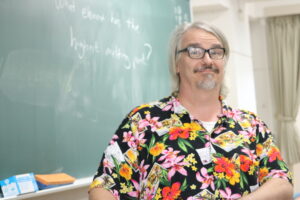
長年、鶴高の生徒たちと向き合い、一人ひとりの成長を見守ってきたジョナサン先生。いつも明るく、ユーモアあふれる姿の奥には、英語教育への情熱と、生徒たちの可能性を信じるまなざしがありました。
インタビューを通して見えてきたのは、いつもの親しみやすい先生の姿だけではありません。鶴高とともに歩んできた日々、そして生徒たちへの温かな想い。
この記事を読み終えたあと、学校でジョナサン先生に会ったら、いつもとは少し違う一面が見えてくるかもしれません。
次回の「Teacher’s Voice」では、どの先生の、どんな一面に出会えるのでしょうか。どうぞお楽しみに!(広報担当)
「鶴高で、逢いましょう。」
インタビューの英語原文はこちらからご覧いただけます。ぜひ、日本語版とあわせてお楽しみください!
Teacher’s Voice
Jonathan —
~Your golden time starts now~
1. My Journey So Far
Interviewer: Welcome, Jonathan! We’re currently preparing the next installment of our series, Teacher’s Voice, and we’re delighted to feature you this time.
Jonathan: That’s wonderful. I feel very fortunate to be here.
Interviewer: To start, could you tell us a little about your background and your journey so far?
Jonathan: Where should I begin?
Interviewer: With your birth.!
Jonathan: All right. I was born in Toronto, Canada, in 1972 to American parents. I’ll leave it as a quiz for our readers to figure out why so many Americans were born in Canada in the early 1970s. Anyway, I’m both Canadian and American.
I lived in Canada until I was 12, and then I moved to the United States. I grew up mostly in the U.S. and attended high school in Dayton, Ohio.
Interviewer: You often talk about your hometown. It’s a really “boring” place, isn’t it?
Jonathan: Yes, my hometown could be considered boring! But, actually, it’s also a place where many things we use today were developed. It’s associated with the invention of the airplane and the electric starter for automobiles, and even the Internet Search Engine.
Interviewer: Really?
Jonathan: Dayton has connections to all kinds of technology and inventions. That’s what makes it such an interesting place to me.
Interviewer: That’s amazing! I had no idea. So Dayton is known for technology and innovation.
Jonathan: There was a time when it was also known for its patents. Pull-tab cans, the kind you open to drink soda, are also associated with Dayton. So are ice cube trays. Dayton is a wonderful place. There are even places downtown that commemorate inventions and innovations that originated there.
Interviewer: You’re proud of your hometown.
Jonathan: Having lived in many different places, I’ve learned that every place has its good points and bad points. Canada, the United States, Peru, and Japan are all the same in that respect. Wherever you live for a long time, it eventually becomes your home, and you begin to see both its strengths and its weaknesses.
So yes, I’m proud of Dayton. But there are plenty of things that could be improved, too.
Interviewer: I love that way of thinking. It sounds very American to me.
Jonathan: Thank you. But I think it applies to everyone, really.
Interviewer: So, what did you do after living in the United States?
Jonathan: I graduated from university with two degrees, one in history and the other in geology.
Interviewer: Two nationalities and two degrees!
Jonathan: That’s right. Two nationalities and two degrees. After graduating, I was hired by a geological surveying company.
My specialty was hydrogeology, which is related to environmental cleanup. I worked to help ensure that the water coming out of people’s taps was clean and safe.
However, the company’s financial situation deteriorated, and its workforce was significantly reduced. Since I had joined relatively recently, I was among those who lost their jobs first.
People working in the same field were losing their jobs across the country, so I couldn’t find another position either.
Interviewer: That must have been a difficult time.
Jonathan: It was. However, I received a fairly generous severance package when I left, which gave me about six months’ worth of salary. I used that money to move to Peru.
Interviewer: Your career path is really unique. For Japanese students, earning two degrees in such different fields as the humanities and sciences is quite unusual. Did that experience influence the choices you made later in life?
Jonathan: If I could go back, I probably wouldn’t do the same thing, and I wouldn’t recommend it to my students, either. I feel I wasted time.
If I could do it again, I would earn one bachelor’s degree and then pursue a master’s degree. With the time and effort I spent earning two bachelor’s degrees, I could probably have earned both a bachelor’s and a master’s degree.
I think it was a mistake. But everyone makes mistakes in life. When you look back, there are always things you think you could have done better. That’s one of the things I would change.
Interviewer: I really appreciate how honestly you talk about these things. So, after that, you went to Peru.
Jonathan: That’s right. I bought a house in Peru and enjoyed living there, but eventually I ran out of money. I had to find a way to support myself.
So I started teaching English in the back of a pub. I was paid five dollars an hour.
Interviewer: In Peru?
Jonathan: In the capital. It was fun. I was young, and I enjoyed teaching English. But I realized that I couldn’t build a long-term career doing that.
So I returned to the United States and earned a teaching qualification to teach English. Then I started looking for places where I could move.
There were four places where I thought I could earn enough to support myself: Argentina, South Korea, Mozambique, and Japan.
I didn’t choose Argentina because I already spoke Spanish. South Korea and Mozambique didn’t particularly appeal to me, so I eventually decided to come to Japan.
Interviewer: So Japan was a country you didn’t know much about.
Jonathan: Not at all. Before coming to Japan, I wasn’t particularly interested in the country, and I knew almost nothing about it.
Interviewer: It must have seemed like a very distant and unfamiliar place.
Jonathan: Yes, I really knew nothing about it. I came to Japan for the money. That was it.
I intended to stay for only five years. I thought, “I really enjoy teaching. I want to make this my career, so let’s give it a try.” But after five years, I planned to return to the United States and look for a job there.
When I first arrived in Japan, I lived in Fujisawa and worked at a school there. Later, I moved to Okayama and worked for one of the major English conversation school companies at the time.
There were four major English conversation school companies back then, but two of them no longer exist. My job involved going to different locations to fill in when problems arose, rather like a substitute teacher. Thanks to that job, I lived in various places across the Chugoku and Shikoku regions.
Eventually, I wanted to build a more stable career teaching English, so I moved back to the Tokyo area. However, I began to feel that there were limits to what I could achieve in that field. You could get promoted to a certain level, but it was difficult to go beyond that. As a foreigner working in Japan, I sometimes felt that advancing my career was challenging.
So I decided to work for a recruitment company that placed teachers in high schools.
Interviewer: And that’s how you ended up at Tsurugaoka.
Jonathan: Exactly. Tsurugaoka was one of the first schools I was assigned to. Actually, the previous teacher had gone back to New Zealand for a holiday, broken his leg there, and become unable to return to Japan, so I was sent to fill in.
Interviewer: What a dramatic beginning!
Jonathan: And that’s how I arrived at Tsurugaoka in mid-September 2002. Now, I’m one of the longest-serving English teachers here! It’s been 24 years.
When I arrived, there were already several teachers who had been working at the school for a long time. There’s also one of my current colleagues whom I could have taught if I had arrived just one year earlier. If I’d joined the school a year earlier, that teacher would have been one of my students.
Interviewer: I have to admire you for staying at Tsurugaoka for so long!
Jonathan: No, you don’t have to admire me. You should ask, “Why is someone this old still here?” But yes, I’ve certainly been here a long time. It’s almost a quarter of a century now.
2. Why Japan Became My Home
Interviewer: You’ve lived and worked in many different parts of the world. Why did you choose Japan as the place to build your life?
Jonathan: Money!
Interviewer: Money!
Jonathan: Well, not entirely. Money was the reason I came to Japan, but it wasn’t the reason I decided to stay.
As my fifth year in Japan approached, I was actually preparing to return to the United States. I even had job interview, lined up there.
But around that time, I met someone very special. She was always smiling, and I remember wondering what made her such a happy person. I wanted to get to know her better, so I asked her out.
We spent a lot of time together, just walking around and talking. On our very first date, we even talked about marriage. We shared our thoughts about the future and the kind of life we wanted to build. By our third date, I knew I wanted to marry her.
That was about 20 years ago, and now we have three children.
Interviewer: So, in the end, it was love that made Japan your home!
Jonathan: You could say that! I had almost decided to leave Japan, but one date changed the course of my life. That’s how a country I originally came to just for work became my home.
Interviewer: What a lovely story. Now, let’s talk about Tsurugaoka.
3. What Makes Tsurugaoka Students Special
Interviewer: I remember you once saying that you like Tsurugaoka students because they’re all “normal.” Could you explain what you meant by that?
Jonathan: Sure. Fortunately, I’ve had the opportunity to teach at junior and senior high schools across Japan with students of widely varying academic abilities. I’ve taught at schools with very different academic profiles, as well as at both girls’ schools and boys’ schools.
Of all the schools where I’ve taught, Tsurugaoka is the most diverse in terms of its students.
Some of our graduates have gone on to become hairdressers, businessmen, government workers, and even Miss JAPAN!. I also know a student who became a successful author while still in high school. I believe the student wrote a book called Surfer in the first year of high school. In other words, the student had already published a book as a high school student.
We’ve also had students with a wide variety of cultural backgrounds and family roots.
Tsurugaoka is truly a diverse school, and our students have all kinds of different personalities. It’s wonderful to see our graduates go out into the world and follow such different paths in so many places.
After seeing so much of the world, I can honestly say that Tsurugaoka is the most diverse place I’ve ever experienced. “Normal” is a compliment.
4. Designing Lessons for Different Ability Levels
Interviewer: I understand that, as the leader of the ALT team, you’re involved in curriculum development and creating teaching materials. First-year students often do pair work, while second-year students have more opportunities for individual presentations and creative projects. What is the thinking behind this approach to teaching?
Jonathan: That’s a difficult but very interesting question.
In first-year classes, I try to prepare activities that students with different levels of English proficiency can all work on successfully.
For example, one of the activities we do early in the first year involves a conversation on an airplane. It’s a very basic and simple activity, but it allows students to respond in different ways.
Even students who aren’t very confident in English can complete the task using the English they already know. Essentially, it’s a situation in which a flight attendant asks a passenger, “What would you like to eat?”
At the same time, the activity is flexible enough for students who are good at English to expand on it and have fun. They can talk about unusual foods or the weather, pretend to be baseball players, or come up with an interesting scenario of their own.
In this way, I try to create open-ended activities in the first year that allow students with different levels of English to participate at their own level.
For example, we’re currently working on kamishibai, or illustrated storytelling. Even students who aren’t particularly confident in English can give a very good presentation. But students who are highly proficient can develop the story further and turn it into something even more interesting.
In the second year, we try to connect our lessons more closely with the content taught by the Japanese English teachers. As a result, we place greater emphasis on grammar and on actually using grammar in practice.
We cover topics such as the five Ws and one H, past participles, and gerunds, and students use them in tasks based on real-life situations.
Interviewer: So you want students to understand how grammar can be used in real life.
Jonathan: Exactly. To me, it’s a little like mathematics. When I was a student, I was terrible at math. I hated it, and I couldn’t understand abstract mathematical concepts.
But in my second year of high school, I started learning mathematics connected to real-world situations, such as banking and science. I was very good at physics because the mathematics was connected to something real.
Students can sometimes become so focused on the details of grammar that they lose sight of how to use it in everyday life.
I want to show students how they can apply the important material taught by their Japanese English teachers to the real world. Our goal is for the Japanese English teachers and us ALTs to work together as partners.
This has been one of my teaching goals for many years. However, we’re now facing a new challenge.
5. English Education in the Age of AI
Jonathan: AI is changing the way we do just about everything. We’re trying to develop a new curriculum that incorporates the tools students are already using and helps them develop the ability to complete English-language tasks effectively with the help of AI.
Rather than pretending AI doesn’t exist or trying to compete against it, we need to think about how to teach students to use it effectively.
When I was younger and still in school, there was something called a graphing calculator. Do you know what that is? It’s a calculator with a screen. You could enter mathematical expressions for topics such as trigonometry and calculus, and it would display the results.
Interviewer: In Japan, we call those scientific calculators.
Jonathan: I see. When graphing calculators first appeared, teachers banned them from their classrooms. They said, “You’re not allowed to use them.”
But about ten years later, schools adapted to graphing calculators and began teaching students how to use them.
I think it’s foolish for teachers to pretend AI doesn’t exist or to assume that students won’t use it in the real world. We need to learn how to teach students to use AI to tackle the challenges they’ll face in their future jobs, businesses, and everyday lives.
That’s the challenge I’m working on now.
I’m trying to develop teaching materials for this purpose. Ideally, I’d like to introduce them into our classes within the next year or two.
Interviewer: I’m looking forward to seeing the new AI-based curriculum!
Jonathan: I hope we can make it happen, too. But it takes time. I started developing it about two years ago, but by the time I had finally put together a good curriculum, AI had already moved on. I had to throw away much of what I had developed up to that point.
But that’s part of the process of trial and error.
6. Helping Students Achieve Their Dreams
Interviewer: You also play an important role in international exchange at Tsurugaoka. In particular, your support for students applying to universities overseas has been invaluable.
Recently, you’ve been helping students with application procedures, essay writing, and advice on applying for scholarships abroad. What motivates you to support students who want to study at universities overseas or pursue international careers?
Jonathan: It’s the same feeling I have toward any student: I want to help them accomplish something.
If I were to describe my role as a teacher, I’d say I’m one step on the staircase that students climb. They use me as a stepping stone, making use of the resources I have to move on to the next step.
I want to provide a foundation that supports students as they continue moving toward their individual dreams. If there’s something I can do to help a student achieve something, that’s what motivates me.
For example, whether a student asks me to help prepare for an Eiken speaking test, write an essay for a university application in Japan, or study for an exam, I want to help in the same way.
There isn’t just one particular thing I want to support students with.
Interviewer: Actually, you’ve been one of those steps on the staircase for me, too.
Jonathan: I’m glad if I’ve been able to play that role.
I believe that living a life in which you’re useful to others is one of the best ways to find happiness.
If you live only for yourself and your own happiness, I think many people actually end up becoming less happy. But when you live to support others, bring happiness into their lives, and help them when they need it, something wonderful happens. The more you give, the more you get back.
The harder you cling to your own happiness, the less happiness you seem to have left. On the other hand, the more you try to live in a way that benefits others, the happier you become yourself.
At least, that’s what I’ve experienced. So, in a way, you could say I do it for myself, too. Seeing other people succeed makes me happy.
Interviewer: That’s wonderful. I feel like this interview will be an unforgettable experience for me, too. You’re an amazing teacher.
7. A Message to Current and Future Tsurugaoka Students
Interviewer: Finally, could you share a message for current Tsurugaoka students and those who may join us in the future?
Jonathan: Never forget that we’re here to help you achieve the things you want to accomplish.
You’re young and intelligent, and you have parents who care about you enough to send you to a school where you can achieve something meaningful.
One thing I’ve noticed about Japanese students is that they sometimes tend to hold back. That hesitation can end up limiting their own potential. I think it’s okay to be more proactive about pursuing what you want.
If you want to become a baker, work in waste collection, study mines, or become the world’s best esports player, go for it. At this stage of your life, all kinds of possibilities are open to you.
The world doesn’t exist independently of human beings. If all of humanity disappeared tomorrow, everything would come to an end. Nothing would continue.
I’m not sure I’m expressing this perfectly, but as time moves forward, the next generation will follow behind you. Right now is your golden time.
My own golden time has already passed. Now my children are in that stage of life. As you get older, you realize that you can’t do absolutely everything you want to do anymore. But younger generations still have so many possibilities ahead of them.
There are countless possibilities open to them.
For example, my own children are also thinking about their future and the experiences they want to have. There are opportunities to learn new things and discover unfamiliar worlds, both close to home and in different parts of the world.
These kinds of experiences don’t necessarily have to cost a lot of money. Your parents will help you, and we teachers will also support you in achieving what you want to do.
If there’s just one image I want you to take away from this conversation, it’s this: go after what you want.
Pursue whatever it is you want to do. At this stage of your life, the world offers you all kinds of opportunities. You’re young, and there are people who want to see you succeed.
As you get older, you may find yourself in a position to use your own experiences to support the next generation. Helping young people succeed and making sure they have access to the opportunities they need is an important role, too.
Don’t let this golden time pass you by. If you do, I think you’ll regret it for the rest of your life.
Interviewer: Thank you so much for sharing such wonderful thoughts with us.
Jonathan: You’re very welcome.
Interviewer: I’ll make sure this becomes a wonderful article. Thank you so much!
Jonathan: Sounds good. You’re welcome.
※